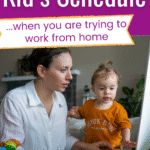
The dream of remote work once conjured images of leisurely coffee breaks. Then reality, in the form of a toddler demanding a snack, hit hard.
Juggling full-time jobs with full-time childcare is the new reality. The line between home life and work life has been trampled by tiny feet. But finding a semblance of work-life balance is possible.
This is why building a work from home schedule with kids is vital for the success (and sanity) of everyone.
It’s about creating a flexible, realistic structure. This framework honors both your work hours and your child’s needs. We’re going to build a sustainable system from the ground up.
Table of Contents
- How To Work From Home With Kids: The Mindset Shift
- The First Step: Audit Your Time and Energy
- Crafting Your Master Work From Home Schedule with Kids
- The Mom Schedule: Juggling Your Many Hats
- Building a Rhythm: The Kids’ Schedule
- The Art of the Juggle: Work From Home Tips
- Your Next Step: From Overwhelmed to Organized
How To Work From Home With Kids: The Mindset Shift
Before schedules, we need a mindset shift. Trying to replicate office productivity at home leads to burnout. Your work day will look different, and that’s okay.
Accept that you will be interrupted. Important calls might happen with a child in the background. Household chores will sometimes linger.
Your goal isn’t perfection. It is to do the most important task well each day. Give yourself grace during these hard times.
The First Step: Audit Your Time and Energy
You cannot build a new, sustainable structure on a shaky foundation. Before you even glance at a planner, the critical first step is turning inward and understanding your own natural rhythms and energy levels. Are you a morning person, capable of tackling your most important task before anyone else is awake? Or do you truly hit your stride after lunch, making that the best time for deep work? This self-audit is half the battle.
The other half is to intimately understand your family’s unique daily flow and schedule. When are your younger kids at their best…right after a nap or after burning energy outside? When do your older children focus best on their homework? You must also note your non-negotiable work hours and identify when your conference calls and important calls are permanently scheduled.

Grab a notebook and spend a couple of days as a detective, simply observing without judgment. This raw intel is absolute gold. Pay close attention to the natural ebbs and flows of your entire family’s energy levels throughout the day. When does frustration typically peak? When is everyone calmest? This crucial insight allows you to strategically align your work blocks with their independent play or quiet time and schedule connection points when morale is low.
This proactive planning, based on real data rather than guesswork, is what transforms a chaotic day into a manageable one, allowing you to finally craft a realistic and effective work from home schedule.
Crafting Your Master Work From Home Schedule with Kids
Your daily schedule is your best friend. It’s a framework that creates freedom within boundaries. It helps you protect your work time.
Think in terms of work blocks. Avoid planning a solid eight-hour stretch. This is key for how to structure a day working from home with kids.
The Golden Hours: Early Morning Block
Use the early morning from 5:30 AM to 8:00 AM. This is your power zone if you’re a morning person. Tackle work that requires intense focus here.
Do this before the house wakes up. This quiet time is perfect for your own work. It sets a productive tone for the day.
The Fractured Hustle: Morning Block
The 8:00 AM to 12:00 PM block is often fractured. Integrate your kids’ class times here. Provide them with a variety of activities.
Your goal is to tackle smaller tasks. Be available for their questions. Squeeze in 20-minute focused sprints when you can.
The Essential Reset: Lunch Time
Lunch from 12:00 PM to 1:30 PM is a hard stop. This time is for food and connection. It is family time, not a working lunch.
Use this break to recharge everyone’s batteries. Step away from your desk completely. This reset is crucial for the afternoon.
The Prime Productivity Window: Afternoon Block
The 1:30 PM to 4:00 PM block is prime time. It ideally aligns with nap time for younger children. For older kids, mandate a quiet time.
Guard this time fiercely. Use it for important tasks or video calls. This is often your second major productivity window.

The Transition Zone: End of Day Wind-Down
Transition out of work mode from 4:00 PM to 6:00 PM. Be present for your kids. Start dinner and handle household chores.
This clear stop signal is crucial. It helps maintain a sense of work-life balance. It marks the official end of the workday.
The Preparation Phase: Evening & Next Day Prep
The evening is for proper family time. Then, take a minute break to review your to-do list. Plan your first thing for the next day.
This simple act sets you up for success. It allows you to hit the ground running tomorrow. This is a cornerstone of creating a work at home mom routine.
The Mom Schedule: Juggling Your Many Hats
The work at home home mom schedule is a chaotic dance. It integrates work tasks with domestic duties. Time management is about intentional batching.
First thing in the morning, don’t check email. Drink water and take five minutes for yourself. This morning routine sets a positive tone.
Batch your household chores efficiently. Do a full load of laundry from wash to fold. Run the dishwasher at night and unload it in the morning.
During a minute break, reset the living room. Wipe down the kitchen table. These little things prevent a total mess later.
If all else fails, lower the bar. Dinner can be sandwiches. Your mental health is more important than a spotless house.
Building a Rhythm: The Kids’ Schedule
Children thrive on predictability. A kid’s schedule reduces anxiety and meltdowns. It provides them with a reliable rhythm.
For younger children, their schedule revolves around meals. Nap time and play are also central. Use visual charts with pictures for their morning routine.
For older children, the day is dictated by class times. Help them build their own routines for schoolwork. Teach them to communicate their needs clearly.
The Art of the Juggle: Work From Home Tips
This is where theory meets reality. Here are practical work-life balance tips for moms who work remotely. These tips are learned through trial and error.
Taming the Screen Time Beast
Let’s reframe the guilt: screen time is a necessary tool for work-from-home parents. The key is to be strategic, not guilty, and to use it as a deliberate lever for your benefit. This means intentionally saving high-value screen time, like a new movie or educational app, for your most important task or an uninterrupted important call.
It’s crucial to remember that not all screens are equal. Online learning for school is a completely different type of work from playing video games for fun. Always differentiate between passive consumption and simply keeping younger kids occupied versus active, engaged learning. A fantastic alternative is utilizing audiobooks; they brilliantly captivate both older children and younger kids without any visual stimulation.
This not only gives their eyes a rest but also allows you to confidently get a lengthy phone call or a chunk of deep work done, making it a strategic and guilt-free choice for everyone involved.
Creating a Dedicated Workspace
Not everyone has a home office, and that’s perfectly okay. The true goal is simply to create a dedicated space, however small, that psychologically signals to both your brain and your family members that you are officially “at work.” This physical boundary is crucial for separating your professional and personal life.
The Kitchen Table Command Center is a common and effective solution for this. To make it functional, use a laptop stand and an external monitor to boost productivity. The key to this method is the ritual: pack all your work equipment into a dedicated basket or box at the end of the day. This act of clearing the space physically reinforces that the work day is over, and it’s time to focus on family life.

It is also essential to signal your work status visually to prevent interruptions. Wearing headphones during critical work blocks is a universal sign for “do not disturb.” For older kids, a simple sign on your chair, like red for “in a meeting” or green for “available for a quick question,” provides them with clear, easy-to-follow guidelines.
Even a simple room divider or a bookshelf can effectively carve out a visual zone in a busy living room corner, helping everyone respect the necessary psychological boundary for you to focus.
Mastering Communication and Boundaries
This is the hardest and most important skill for any working parent. You must communicate your work schedule clearly and consistently with all family members. For example, explicitly explain to younger kids when you have an important video call and cannot be interrupted. A great idea is to reward their cooperation and quiet time afterward with dedicated, device-free quality time.
Furthermore, be proactively transparent with your colleagues and clients about your integrated home life; most people are incredibly understanding. Use your shared digital calendar to visibly block out focus time for deep work and school support hours for online learning. Most importantly, learn to communicate with yourself, honoring those boundaries to fiercely protect your precious free time and prevent burnout.
This ongoing dialogue is the cornerstone of sustainable remote work.
Leveraging Help and Finding New Ways
Trying to do it all alone is a disaster. Get creative with support systems. This is a vital part of how to structure a day working from home with kids.
Tag-team with your partner if possible. Split the day into shifts. One manages work hours while the other manages the kids.
If the budget allows, hire professional help. Even a couple of hours a week is transformative. It helps you hit critical work project deadlines.
Swap kids with other work-from-home parents. This is a great idea for socialization. It provides you with a solid block of time.
Embrace your village. Grandparents can help with online learning. They can provide a fun distraction via a Zoom phone call.
Navigating the Inevitable Challenges
Some days, the wheels will fall off. A child will get sick. A project will run long.
For sick children, your work schedule disappears. Communicate with work immediately. Focus on cuddles and comfort.
During long days, be extra intentional about family time afterward. Order pizza and put on a movie. Explain to older children that it’s a temporary crunch.
When you hit a wall, take a real break. Go for a walk or listen to music. A reset is more productive than staring blankly at a screen.
The End of The Day Ritual
How you end your workday is crucial. Without a commute, you must manufacture a shutdown ritual. Review your to-do list and plan for the next day.
Then close the laptop lid. Physically put it away out of sight. Tidy your workspace to signal the shift to home mode.
Be fully present at the end of the day. Ask your kids about their day. Cook together and put your phone in another room.
Your Next Step: From Overwhelmed to Organized
Building a work-from-home schedule with kids is iterative. What works the first week might need tweaking. Be patient and experiment with different ways.
Remember, you are not just working from home. You are home, working. You get to witness the little things and the impromptu dance parties.
Embrace the chaos and protect your peace. You are navigating this unprecedented time with strength. You are building a family life that integrates all parts of you.
Let’s be honest: even with this entire list of tips, some days will feel utterly chaotic. If you’re reading this, thinking, “This is great, but my situation is impossible,” you are not alone. That feeling of being pulled in a million directions is the reality for every working mom navigating remote working. But what if you could find a clear starting point to reclaim your sanity?
You don’t need to figure it all out at once. The best tip is to start small. Maybe your best time for deep work is during your toddler’s reading time with audio books. Perhaps creating a designated play area with a baby gate and their favorite toy buys you a crucial little while. It could be as simple as putting on a face mask during your break to reset, or swapping child care with family members for a little while to focus.
These small wins are the good things that build momentum.
If you’re ready to transform that overwhelming feeling into an actionable plan, I’ve created a resource just for you. For less than the cost of a fancy coffee, my “Your What-If List” PDF guide helps you cut through the noise. It’s designed to help you pinpoint the one simple shift that will make the biggest impact on your family schedule and daily routine. You’ll identify the best ways to structure your day, protect time for the important things, and finally achieve that elusive balance.

As a special bonus, you’ll get instant free access to my 45-minute “Pockets to Profits” webinar. It will teach you how to use those small windows of time, like the quiet after nap time, to explore your skills and create exciting new possibilities, whether that’s excelling in your current remote job or discovering a new type of work that fits your life.
Consider this your low-risk, high-reward first step. Stop scrolling social media for answers and start building a daily routine that works. It’s time to turn those “what-ifs” into your new reality.